

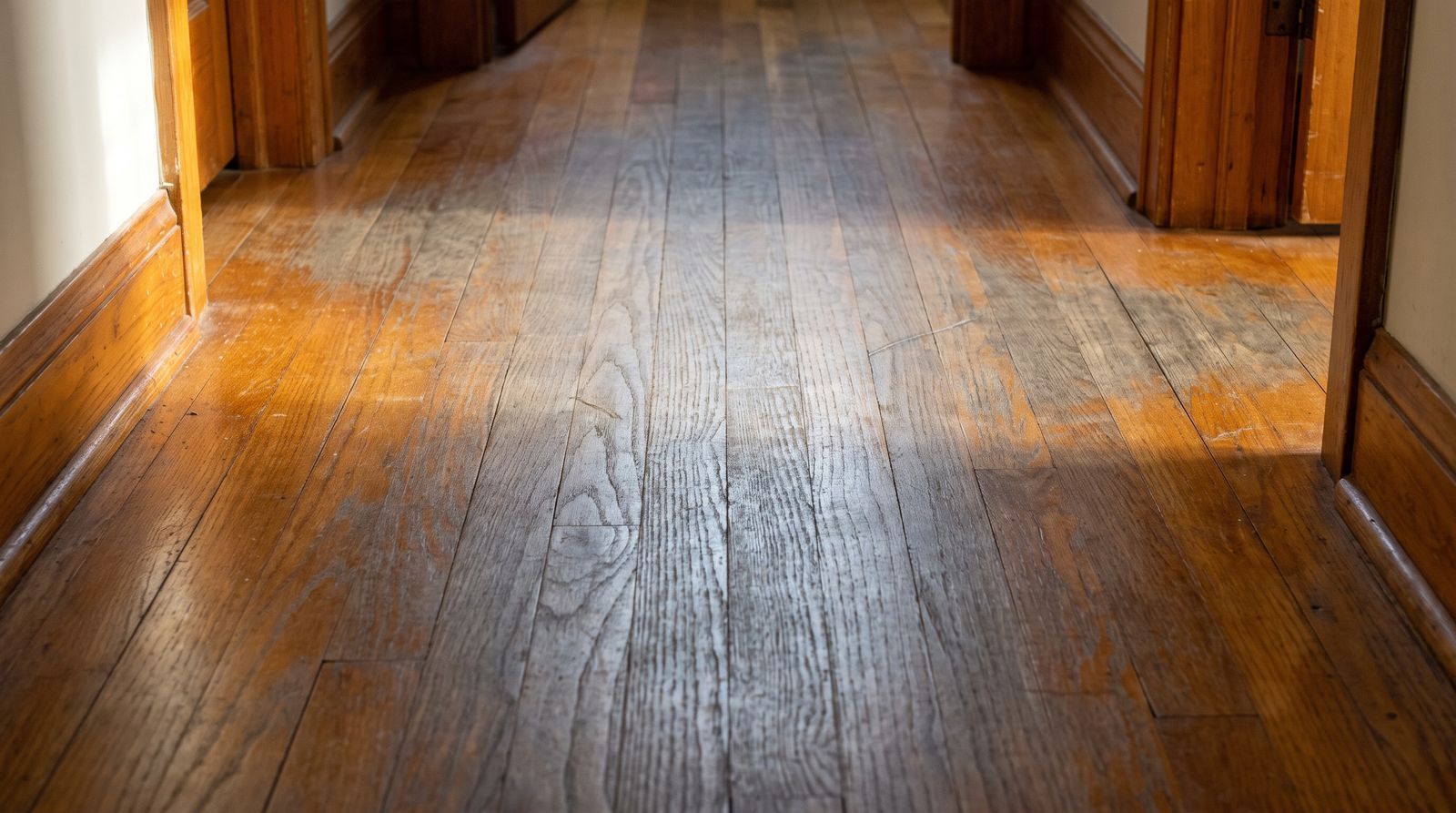
If a scratch is deep enough to catch your fingernail and it's down to bare wood, if the floor has gone gray in high-traffic areas, or if water no longer beads up on the surface, that's a real sign the finish is worn through and it's time to refinish. Surface scuffing and dullness with an intact finish usually means something less invasive, a screen-and-recoat, not a full sand-down.
We get asked this a lot: "does my floor actually need refinishing, or am I just noticing it more?" There are a few simple checks that answer that honestly, without guessing.
Check OneThe Fingernail Test
Run your fingernail across a scratch. If your nail catches and drops into the groove, the scratch has gone through the finish and into the raw wood underneath. That's different from a surface scuff that just dulled the shine, once wood is exposed, it's no longer protected from moisture and dirt, and it'll only get worse from here.
Check TwoGraying, Especially in Traffic Paths
If you notice the floor turning gray in the hallway or in front of the sink, somewhere that wasn't gray when the floor was new, that's usually not age. It's the finish wearing thin enough that moisture is starting to reach the wood itself. Graying is one of the more reliable signs that a floor needs attention soon, not eventually.
Check ThreeThe Water Drop Test
Put a few drops of water on the floor in a spot you don't mind testing. If the water beads up and sits on the surface, the finish is still doing its job. If it soaks in within a minute or two, the protective layer is gone in that spot, and the wood is absorbing moisture directly. Wipe it up right after either way, but the result tells you a lot.
Before You Assume the WorstNot Every Dull Floor Needs a Full Refinish
A floor that looks tired but passes the fingernail and water tests, no exposed wood, finish still beading water, often just needs a screen-and-recoat. That's a much lighter process: the top layer gets lightly abraded and a fresh coat of finish goes on, without sanding down to bare wood. It only works if the existing finish is still intact enough to bond to, which is exactly what those two checks tell you.
The Question After ThatHow Many Times Can This Actually Be Done?
Solid hardwood can typically handle a full refinish 4 to 6 times over its life, though that depends heavily on the thickness of the boards. A standard ¾-inch solid board usually has room for 4 to 5 refinishes; thinner boards have less to give. Each sanding removes a thin layer of wood, so it's not unlimited, but for a lot of homes, that's still decades of use left in the original floor.
Engineered hardwood is more limited, usually 1 to 3 refinishes total, since the real-wood top layer is thinner to begin with. And even those numbers aren't a guarantee every time, how many passes a floor has left depends on how much wear layer remains and what kind of shape it's already in, not just what type of wood it is.
A Few Things People Actually Ask Us
My floor looks dull but I don't see any scratches through to the wood. Does it still need refinishing?
Not necessarily. Run the water drop test first. If the water still beads up, a screen-and-recoat is usually enough to bring the shine back without a full sand-down.
Is graying always caused by water damage?
Not always active water damage, but it does mean moisture is reaching the wood more than it should be. Sometimes that's spills, sometimes it's just humidity getting through a worn finish over years.
Can I do the water and fingernail tests myself before calling anyone?
Yes, both take under a minute and don't require any tools. They're a good way to know what you're actually dealing with before deciding on next steps.
What happens if I keep waiting after the finish is worn through?
Exposed wood picks up stains and moisture damage that a simple refinish can't always fully remove, sometimes deep enough that boards need to be replaced instead of resurfaced. Catching it at the graying stage is a lot easier to fix than catching it after staining sets in.
Not sure which category your floor falls into? Ask us to take a look, the fingernail and water tests only tell you so much, and we're happy to walk through it with you in person.