

Walk into a Northern Virginia home in early September and you can usually spot the damage from the doorway.
A slow wave across the dining room floor. A strip of pale wood next to the south-facing window. Fine concentric scratches radiating out from where the kitchen chairs sit.
None of it was inevitable.
Three quiet forces work against hardwood floors between Memorial Day and Labor Day. They're predictable. They're slow. And they're almost entirely preventable, but only if you know what to look for, and only if you act before they start.
This is the guide we give our own families. Three habits, none of which require us, all of which add years to the life of a hardwood floor. Read it once. Do the fixes this weekend. Head into July with the floors in the same shape you left them in April.
Three things to do this weekend:
- Get a $12 hygrometer. Keep your indoor humidity between 35–55%.
- Replace the felt pads under every dining chair, stool, and barstool.
- Rotate every rug a quarter-turn now. Do it again in August.
Total time: a Saturday morning. Total cost: under $100. Worth: roughly the cost of a refinish in 2030.
Why a Northern Virginia summer is so hard on hardwood
By August, outdoor humidity across Northern Virginia averages above 70%. Inside the older homes we work in most (Arlington Craftsman bungalows, Vienna colonials, Alexandria row houses, McLean ranches), that translates to indoor humidity in the 60–75% range whenever the AC can't keep up.
At those levels, your floor isn't sitting still. It's quietly absorbing moisture, swelling at the edges, pushing against neighboring boards. Stack that against long, bright days and west-facing windows, and you've got two slow-acting forces working at the same time. Moisture from below. UV from above.
Most homeowners don't notice the damage until September, when the boards finally relax and the cupping shows up as visible waves across the dining room. By then it's set.
The fix isn't expensive. It's just early.
Habit One: Hold your humidity between 35% and 55%.
Last July, we visited a homeowner in Falls Church whose three-year-old white oak floor was starting to cup. She had her AC running. The boards looked wavy across the dining room.
We checked her hygrometer: 68%. The moisture was coming up from a damp basement she'd never thought to worry about. The fix took two weeks. She added a $180 dehumidifier downstairs, held her humidity between 35–55%, and the boards relaxed back into place.
That's why this is Habit One. It's invisible until it isn't. And when it isn't, it's expensive.
Why hardwood actually cares about humidity
Wood is hygroscopic. It absorbs and releases moisture from the air around it, the same way a sponge does. A 1% change in moisture content can change a board's width by up to 0.25%. Multiply that across 20 boards in a row, and you have enough movement to crown edges, close seams, and stress the finish.
Three numbers to remember:
- Above 60%: Boards swell. Edges crown. Gaps disappear. The finish can crack.
- Below 30%: Boards shrink. Gaps open between every plank. Squeaks develop.
- 35–55%: The sweet spot. Floors stay flat and quiet.
How to measure it (and what to do about it)
Buy a digital hygrometer on Amazon for $12 to $20. Put it in the room with your hardwood floor, centrally, away from vents and windows. Check it once a week. That's the whole monitoring system.
Your AC removes humidity as a byproduct of cooling, so main living areas usually stay in range. The problem rooms are the ones nobody thinks about: basements, sunrooms, three-season rooms, and any space with poor airflow. A $150 portable dehumidifier handles most of these. For whole-home solutions, an HVAC-integrated dehumidifier runs $800–$1,500 installed, and pays for itself the first time it prevents a refinish.
If your hygrometer reads above 60% even with the AC running, you don't have a humidity problem. You have a moisture intrusion problem. Old window seals, basement leaks, leaky crawlspaces. Find the source before you spend money on dehumidifiers, or you'll just be treating the symptom.
Habit Two: Refresh the felt pads on every chair.
Try this right now if you're near a hardwood floor:
Pull a dining chair out from the table. Look at the floor where the chair legs sit.
See fine concentric scratch marks radiating outward from each leg position? That's the signature of old felt pads quietly working like sandpaper across your finish, sometimes for years before anyone notices.
Felt pads are consumables, not forever-fixtures. We tell every customer this on installation day. Almost nobody actually replaces them on a schedule. By the time someone calls us about scratches, the original pads are usually four or five years old.
The sandpaper effect
Here's what happens to a felt pad over time. It flattens under load. Then it picks up grit from the floor: dust, sand, kitty litter, breadcrumbs, anything small enough to embed. Once embedded, the grit doesn't come out. Every time you slide that chair back from the table, you're dragging an abrasive across your finish.
A year of this and you can usually see the result without trying.
The replacement schedule
- Dining chairs: every 12 months
- Barstools and counter stools: every 12 months
- Office chairs on hard floors: every 6 months
- Anything with casters: inspect every 6 months, replace when the rubber compresses
The 10-minute process
Tip the chair on its side. Peel off the old pads. Wipe each leg with a damp cloth (you'll usually see grit in the residue). Let dry. Apply fresh pads. One room takes ten minutes. A whole house takes a Saturday morning.
If you have rolling stools at a kitchen island, swap the wheels from carpet casters to rubber-tired hard-floor casters. They cost $5 each. They roll better. And they're the single biggest hardware upgrade you can make for a kitchen hardwood floor.
Habit Three: Rotate your rugs before the sun does its work.
Try this one too:
Lift the rug in your living room. Look at the floor underneath. Look at the floor next to it.
If you can already see the rug's outline, UV has been doing slow work all year. A Northern Virginia summer is about to accelerate it.
UV is the slow killer. Unlike humidity damage (which can sometimes reverse when the season changes), UV damage is permanent. The only fix is a refinish, and even then, the species' baseline color may have shifted forever.
What sunlight actually does to wood
Every species shifts, but they shift differently:
- Red oak turns amber.
- White oak ambers slightly, then deepens.
- Cherry darkens dramatically, sometimes 2–3 shades in a single summer.
- American walnut actually lightens. (The only common species that does.)
- Maple yellows over time.
- Brazilian cherry, tigerwood and other exotics shift most dramatically of all.
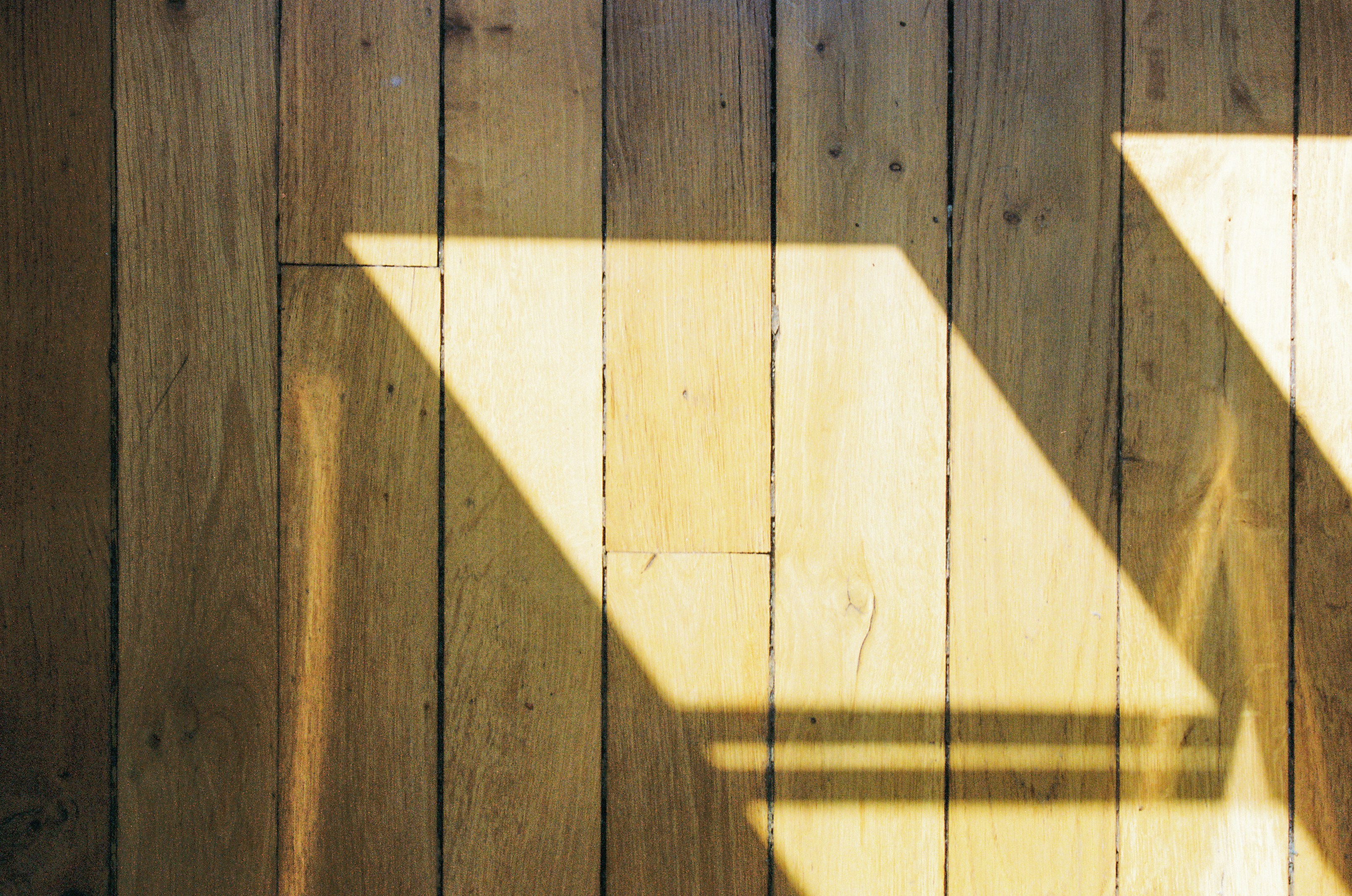
The damage you actually notice isn't the color shift. It's the uneven shift between covered and exposed wood. By September, you'll have a visible rectangle on your floor that exactly matches the rug's footprint.
What to do this weekend
- Lift each rug. Compare covered floor to exposed floor.
- Rotate each rug 90° (a quarter turn). Don't flip it. Just turn it.
- Mark your calendar for August. Do it again.
The bigger fix worth considering
For rooms with serious sun exposure (south- and west-facing windows in Arlington row houses and Vienna townhomes get punishing afternoon light), the real long-term answer is window treatments during peak hours, roughly 11am to 3pm. Sheers, blinds, or even half-closed Roman shades cut UV exposure significantly without making the room feel dark.
For high-value floors (heart pine, quarter-sawn oak, exotic species), UV-blocking window film is the best investment we know of. It's invisible from inside. It lasts 10+ years. It cuts UV transmission by 80–90%. Installed cost runs $8–$15 per square foot of window. We've seen it pay for itself within five summers.
When it's time to call a professional
Most summer hardwood issues are preventable or recoverable with the three habits above. Some aren't.
Here's a quick test: stand at one end of your room. Squat down until your eye is at floor level. Look across the boards.
If you see a slow ripple, like waves moving across the planks, that's cupping that may already be set. Call us.
Other signs the damage has moved past DIY territory:
- Cupping that doesn't relax when humidity drops in the fall. Once cupping is set, sanding is the only fix.
- Finish wearing through in traffic lanes. Bare wood in front of the kitchen sink means the topcoat is compromised.
- Gaps that don't close in summer. Permanent gaps usually mean the floor has lost moisture below the safe range, often a structural humidity issue worth investigating.
- Squeaks that have appeared in the last 12 months. New squeaks mean new movement.
- A visible outline beneath your rugs. UV damage already done. Plan a refinish in the next few years.
If any of these describe your floor, schedule a hardwood checkup. We'll come out, take a look, and tell you whether it's a "do this Saturday" fix or something worth professional attention. No pressure. The visit is free.
The Summer Hardwood Checklist
Print this. Stick it on the fridge. Knock through it on a Saturday morning.
- Buy a digital hygrometer ($12–$20)
- Place it in the room with the most hardwood
- Confirm humidity reads 35–55%; adjust AC or add a dehumidifier if not
- Replace felt pads on every dining chair, stool, and barstool
- Swap office chair casters to hard-floor type if needed
- Rotate every rug a quarter-turn
- Identify south- and west-facing rooms; close blinds 11am–3pm
- Schedule a professional checkup if you see cupping, gaps, or finish wear
Frequently Asked Questions
How often should hardwood floors be refinished?
A well-maintained floor needs refinishing every 8–12 years, depending on traffic. Floors that get the maintenance described above (humidity control, fresh felt pads, regular rug rotation) can go 15+ years between refinishes. Floors that don't can need attention in as little as 5–6 years.
Can I prevent sun fading completely?
You can't stop UV entirely, but you can dramatically slow it. Rotating rugs every 2–3 months is the biggest single move. Window treatments during peak sun hours help. For serious exposure, UV-blocking film cuts UV damage by 80–90% and lasts 10+ years.
What's the ideal humidity for hardwood floors?
Between 35% and 55% relative humidity, measured indoors with a digital hygrometer. Below 30%, gaps appear and boards may crack. Above 60%, boards swell and edges crown.
Does engineered hardwood have the same humidity needs?
Engineered hardwood is more stable than solid. The cross-grain construction resists expansion, but it still has limits. Most manufacturers recommend the same 35–55% range, though engineered floors handle the edges of that range better than solid.
What cleaner should I use on my hardwood?
Use a cleaner specifically formulated for hardwood. Bona Hardwood Floor Cleaner and Method Squirt + Mop are both safe for polyurethane finishes.
Never use water alone(it seeps into seams and causes cupping), never use vinegar(acidic, dulls finish over time), and never use wax-based products on a polyurethane floor (they create a haze that's very difficult to remove).
My rug left a lighter rectangle on my floor. Is it ruined?
Not ruined. Just visible. The color difference will become less obvious over time if the previously-covered area is now exposed to the same light as the rest of the room. If it bothers you, the only permanent fix is a refinish. For now, leave the rug off (or move it) and let the floor catch up.
Do you only service Northern Virginia? What about DC and Maryland?
We're based in Northern Virginia (that's home), but we work across the entire DMV. Arlington, Alexandria, Fairfax County, McLean, Vienna, Bethesda, Chevy Chase, Silver Spring, Potomac, Rockville, and the District itself. If you're not sure whether we cover your area, give us a call at (571) 998-1455 and we'll let you know.
One short email a month. No fluff, no sales.
Practical hardwood advice from the people who actually do the work, written for Northern Virginia homeowners. One piece, one tip, the first Saturday of every month.
Sign Up FreeHave a question about your floors?
We read every email and every voicemail. If you've got something specific going on, let us know. Happy to help even if you're nowhere near ready to hire us.